

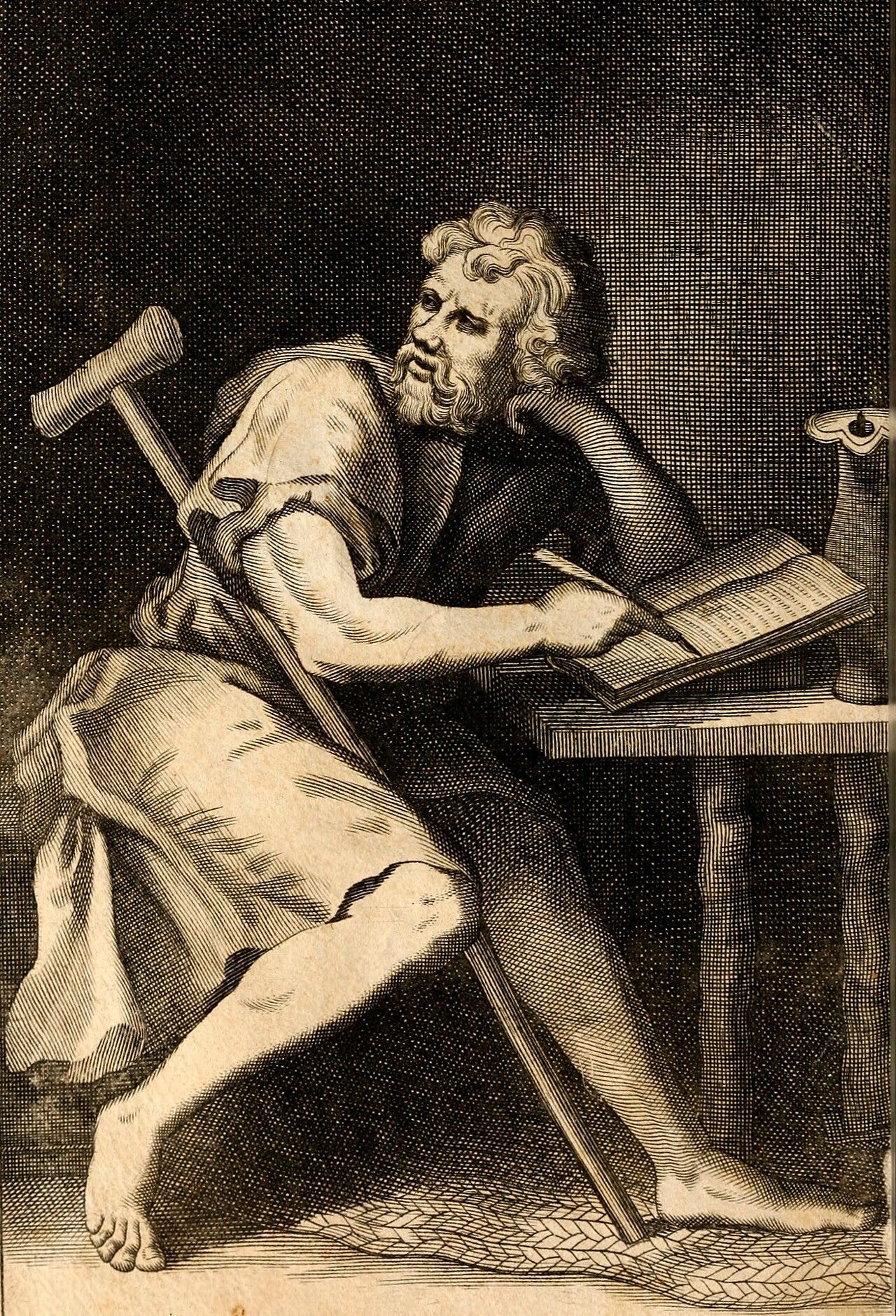
Epictetus’ Handbook famously opens with what is called today the dichotomy of control.
“Some things are up to us and others are not. Up to us are opinion, impulse, desire, aversion, and, in a word, whatever is our own action. Not up to us are body, property, reputation, office, and, in a word, whatever is not our own action.” (Handbook 1, Trans. Robin Hard)
At its simplest, the argument goes something like this:
Everything in the world is either up to us or not
If we want to be happier, better people, we need to treat each category appropriately.
This means (among other things):
Treating our opinions, choices and values with the proper care and attention they deserve.
No holding on too tightly or rigidly to the things not up to us, like our reputation, career, or the opinions of other people.
This is a central claim for Epictetus. Arguably the core of his method of Stoic education. (Caleb and I did a whole podcast episode on it, and its common misinterpretations).
The term dichotomy of control, as far as I can tell, was coined by Professor William Irvine in his 2009 book A Guide To the Good Life. In that book, Irvine also introduces a potential update, or clarification of Epictetus’ key division - the trichotomy of control.
I still see discussion of the trichotomy of control online. However, I don’t think the idea is helpful or accurate for practicing Stoicism in your own life.
What is the trichotomy of control?
The trichotomy of control says that Epictetus division is too simple. Epictetus either missed, or more likely failed to highlight, a third category. That category is things we influence. So the dichotomy needs to be updated.
Irvine presents the idea in the following way:
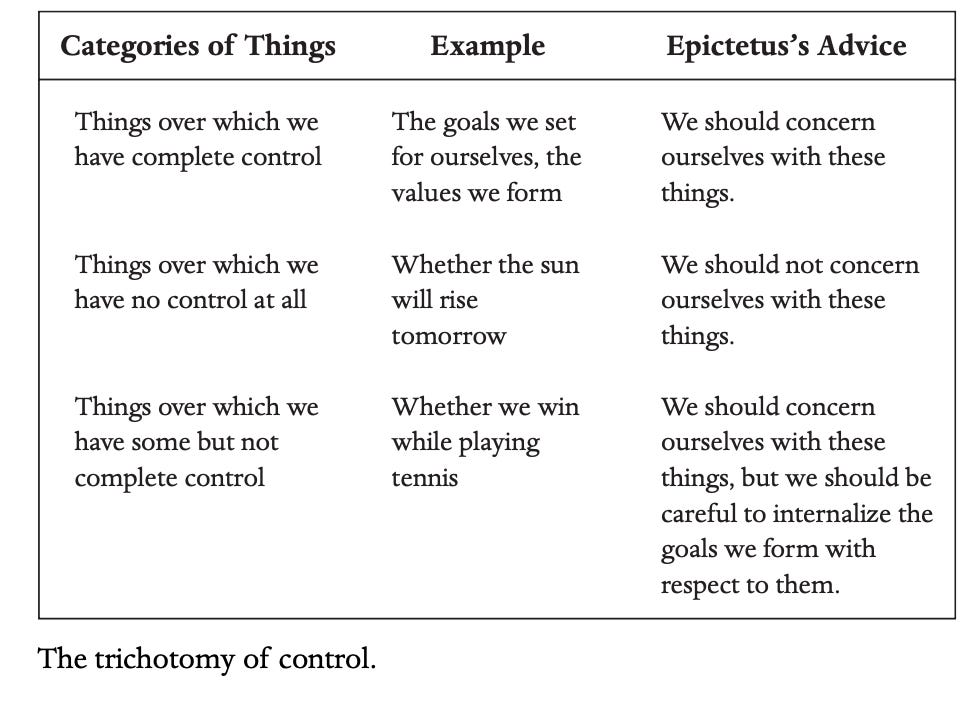
The argument is that Epictetus’ dichotomy works as a practical guide for how to live by providing categories with specific instructions, but two categories are not enough.
I shouldn’t treat a tennis match as if it is something entirely up to me, but it’s also defeatist to treat it like something entirely out of my control, like the rising of the sun.
We need a third way of interacting with the world, a way of handling things we influence. For these situations that we influence but do not control, Irvine says we should care about the outcome, but set internal goals. I want to win the tennis match, but this is in service of an internal goal, for example to try my hardest or improve my tennis skill.
I want to lose weight, but this is in service of the internal goal of improving my temperance. I want to progress in my career, but this is in service of an internal goal of developing my wisdom and work ethic.
It’s an intuitive idea, but it doesn’t work. More precisely, it is useful advice that should not be presented as an alternative to the dichotomy of control.
What the Trichotomy of Control Misses
The trichotomy of control is a trap. Not only is it not what Epictetus argued, practicing it can also obscure or detract from Epictetus’ actual lesson.
The problem with the trichotomy is that it assumes Epictetus’ point is that there are some things we control, and some things we don’t.
And if that is Epictetus’ point, then it is natural to object that there is a whole category missing: The things we kind of control, the things we influence.
But this is not what Epictetus’ division is about.
It is instead a fundamental divide between two kinds of things that have two different sets of properties across value, responsibility and more:
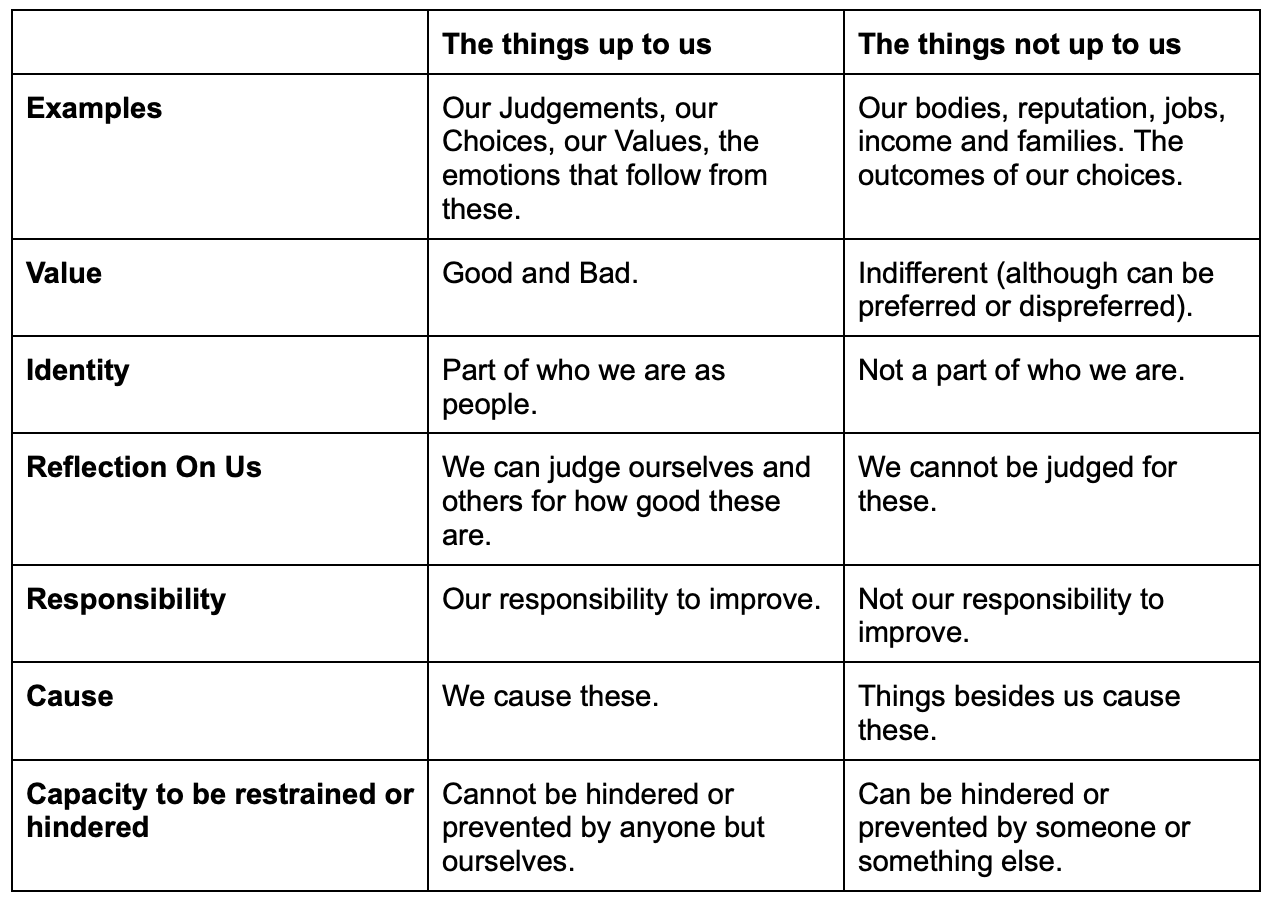
What could be called control (but is really better thought of as what we cause or is up to us) is only relevant for the last two categories! By reducing Epictetus’ key distinction to a spectrum of ‘control’ you obscure this other part of the lesson.
Epictetus is not only asking us to realize that we can’t control other people (as good advice as that may be).
Rather, Epictetus is also asking us and his students to reorient their entire value system and sense of identity. There are only a few truly good and bad things in the world. And these include the choices and judgements you make, and the emotions and desires that follow from them.
These are also the things you can be judged by, because they are who you really are, and because they depend on you.
Epictetus is making a divide foundational to Stoic thinking between two different kinds of things. The trichotomy of control entirely misses this by doubling down on the control part.
How to think about what we influence instead
But, what about the things we influence? We still want to be able to handle the tennis match and the job interview. We want to make the most of the things we can influence, without getting too upset if they don’t go our way.
How can we do that if we are only supposed to focus on the things up to us?
Well here is an alternative for how to do that. Instead of creating a third category of things we influence, we can approach these situations with the dichotomy of control in mind, as long as we frame it properly.
What it means for something to be influenceable is that our choices matter for the outcome. So really, anything influenceable is still just reducible to a combination of things up to us (choices/judgements) and things not up to us (the behaviour of our opponent, the weather, the mood of the referee). The dichotomy works perfectly. See the example below:
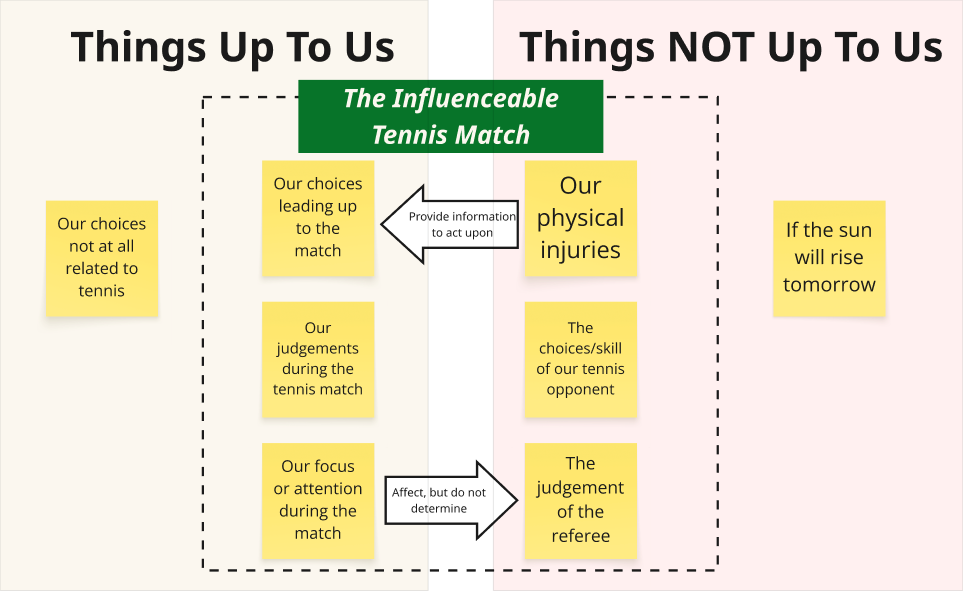
The tennis match is a combination of the things up to us and not. When engaging in a match, our job, as Stoics, is to focus our attention and effort on the proper side, while still taking in information from the things not up to us where relevant.
Stoics care about how things turn out. They prefer to win a tennis match. But they don’t judge themselves as a player by if they win (a good player may injure their knee mid-match, or face a biased referee).
Likewise, in life, the good person prefers a certain outcome in their family, work, social life, but does not base their happiness on it.
So if something is influenceable, if our choices may change or affect what happens, then we should reflect that in how we act. But the situation is still only made up of things up to us, or things not.
This is the key takeaway of the dichotomy of control. I try my hardest in the tennis match, not because the tennis match is up to me, but because my choices are. And trying your best at things, whether that’s tennis, work, family or self-improvement, while also accepting that some of those things are not up to you is one of the best Stoic lessons to learn.