

If politics makes you unhappy, that’s a you problem
It isn’t the things themselves that disturb people, but the judgements that they form about them.
Whether it’s the economy, uncertainty, or political uncertainty – many believe that political turmoil and unjust systems threaten our pursuit of happiness.
And yet the Stoics say that externals do not make life better or worse.
A Stoic hears of political struggles and says – so what?
Injustice may call for action. But it doesn’t force unhappiness on anyone.
As Marcus Aurelius exhorted of himself:
Does what’s happening keep you from acting with justice, generosity, self-control, sanity, prudence, honesty, humility, straightforwardness, and all the other qualities that allow a person’s nature to fulfill itself?
Meditations 4.47
No. What makes a life good or not is what is up to you. Your character. Who you are. If you’re an excellent and skilled person, you’ll find happiness. The good news is you don’t need a president, political system, or your favorite policies to live well.
If it feels like politics is standing in the way between you and the good life, that’s an issue with how you think.
Stoics fought tyrants, practiced statecraft, and advocated for justice. This isn’t a point for political passivity. If you think that, you’re not paying attention.
Anger is never appropriate
The world is full of corruption, incompetence, and injustice. All of these call for outrage. From small but outrageous restrictions on liberty, to pointless arrests, to blatant corruption, to unspeakable massacres – the political sphere offers ample opportunity to become enraged. Personally, I find that it’s often the small things that make my blood boil.
And yet the Stoics were against anger, even righteous anger. In fact, Seneca says it is nothing more than temporary insanity: brevis insania. The other Stoics say the same thing.
Anger is grounded on an unrealistic view of human nature. The fact of the matter is that we live in a world full of envy, deceit, viciousness. Everyone learns this early in life. In such a world you should not be surprised at the extent of injustice. When you are not surprised, anger does not get started. It is when our expectations are violated that anger truly kicks off. It’s the enraged people who have an unrealistically optimistic view of human nature.
The Stoics saw the desire for revenge as essential to anger. Revenge for its own sake is never right. Other people cannot harm us. The Stoics really mean that. According to them, we misspeak when we say that other people make us angry. Our judgments play an essential role.
What matters, in every situation, is that everyone involved acts with justice. When people become angry they lose sight of this basic fact.
Neither Victimhood nor victory is a moral credential
In modern countries many victims get a pass. Some people put the poor, minorities, or the middle class on a pedestal. Political policy ought to be governed by them. Others put the victorious on the pedestal. The rich, beautiful, and famous get extra points in the political parade.
For the Stoics, this isn’t so. For them, wealth is preferred, poverty is not. The rich may have insights that the poor do not – and the reverse. But neither has any moral advantage. Rhetorically, appeals to either should have limited power.
But I think the deep point is that both wealth and poverty have different risks. With wealth comes decadence, envy, and pride. With poverty comes sloth, resentment, and servility.
What’s relevant are rights, wrongs, duties, fairness. Neither victim or victor necessarily has insight into either of these.
You don’t get to choose all of your roles
Modernity worships self-expression and the freedom to be whoever you want to be. The point of life is to choose your life. This was captured by the philosopher Rousseau, who declared that ‘Man is born free’ - expressing the idea that we should throw off the unchosen obligations life burdens us with.
Once I heard a fellow millennial say they didn’t love their parents because they wouldn’t like them if they met them at a party. This perfectly captures the modern attitude.
But this perspective is alien to the Stoics. For them, you have social roles that are unchosen. Here’s Epictetus:
It is necessary that I not be unfeeling as a statue, but that I preserve my relationships, the natural and acquired ones, as a pious man, son, brother, father, and citizen.
Discourses 3.2
Not a bad list. Some of those things, family being the obvious example, you don’t get to choose. Instead, the Stoics agree with Confucians:
We are not born free. We are born with obligations to the parents and other relatives who will raise us to adulthood, to teachers who shape us far beyond what is required to just earn a paycheck, and to the preexisting civilization that makes all our individual contributions possible.
Bryan W. Van Norden, Confucianism in How to Live a Happy Life
Self-expression matters – but a kind of rootless freedom denies who we are. Grown ups may tell kids they can be whatever they want when they grow up, but they don’t really mean it. A philosophy which doesn’t recognize limits and the fact that who we are depends on things we’ve never chosen is immature.
Nearly everyone today lives in luxury
The Stoics made fun of their students for being rich. They said it will make them soft, effeminate, and lazy.
Remember, the students of Stoics like Epictetus and Musonius Rufus were effectively rich Roman aristocrats. Their parents had slaves and servants and nice furniture. A future of fine comforts, entertainments, and villas was in their cards.
Here’s the issue. Today nearly everyone in developed countries lives in luxury. The USA is orders of magnitude richer than the Roman empire. The analyst Vaclav Smil said that the typical American wields the energy equivalent of at least 200 slaves. But even that’s not enough:
And a Roman imagining a life with 200 personal slaves would still get a grossly inadequate impression of modern advantages because even those scores of servants and laborers could not provide energy services comparable in terms of convenience, versatility, flexibility, and reliability with those delivered by electricity and fossil fuels: no filling of oil lamps, no fiddling with wicks, no preparation of kindling. No lighting of charcoal, no frequent stoking of a wood fire, no heavy smoke from insufficiently air-dried wood, no scraping out of ashes from a bread oven, no carrying of heavy shoulder loads, no dragging of a recalcitrant mule or donkey—just a flip of a switch, a turn of a key, numbers punched into a thermostat are enough to start flows of perfectly regulated and amazingly reliable light, heat, or kinetic power.
Why America Is Not A New Rome
Remember what even rich Romans needed to deal with. Today’s bread and circuses, electricity, health care, and resorts would shock them.
I don’t think it would surprise the Stoics to see the resulting vices that come from modern affluence.
Some lives are better than others
In True Detective, Rust Cohle says:
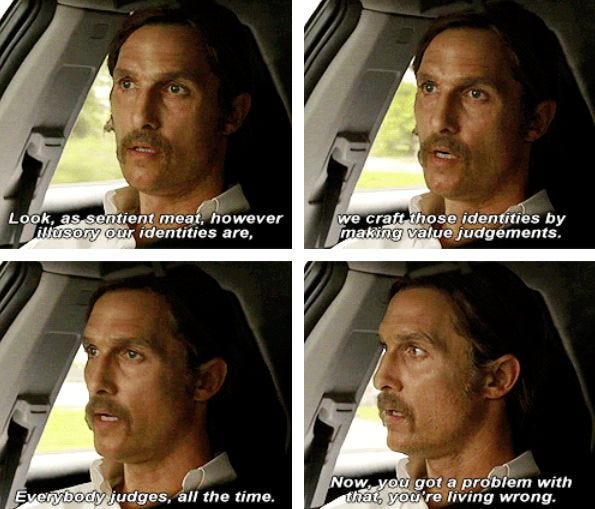
Look, as sentient meat, however illusory our identities are, we craft those identities by making value judgments: everybody judges, all the time. Now, you got a problem with that... You’re livin’ wrong.
The Stoics agree – at least with the last element. Some lives really are better or more preferable than others and should be judged accordingly.
In a way, this is not even that politically controversial.
A greedy life focusing on maximizing wealth over everything else is probably bad. People say stuff like this all the time.
I think it’s the consistency that gets people like the Stoics into political trouble. Every decision we make, including personal ones, is subject to judgment.
This doesn’t mean Stoics are dogmatic moralists. They are hesitant to make judgements about specific people. Most of us live in vice. But at the level of patterns? They are comfortable making judgments. You can’t make good decisions without doing so.
No one intends to do evil
Surely you might say, Callicles, whether you think that Polus and I were right in admitting the conclusion that no one does wrong voluntarily, but that all do wrong against their will?
We all believe that though some political enemies may be very fine people most of them are stupid, insane, or evil. Although the Stoics may agree with the first two – depending on the case – they put a question mark on the last one.
In their view, no one intends to do evil. This includes the most horrendous figures.
I personally find this a challenging doctrine.
But they argued that everyone is attempting to do good by their lights. Those who do evil are doing so out of ignorance, not malice.
This is why Epictetus says:
So whenever someone assents to a falsehood, you can be sure that it’s not the falsehood to which he wished to assent—for no soul, as Plato says, is willingly deprived of the truth—but that he judged something false to be true.
Discourses 1.28
And Marcus Aurelius makes explicit reference to the same passage and doctrine:
“Every soul,” says Plato , “is deprived of the truth against its will.” And the same holds true of justice, temperance, benevolence, and all such virtues. It is therefore absolutely necessary to remind yourself of this constantly. Thus, you will be more gentle with others.
Meditations 7.63
Like Plato, the Stoics followed in the footsteps of Socrates here. Socrates argued that men always attempt to do good. Sin is not the result of malice, but ignorance. We must always treat people, ourselves and others, with this in mind.
Really thoughtful piece, Caleb — I especially appreciated the emphasis on inner authority.
One place I see things a little differently is around emotion and political strain.
The Stoics said externals don’t determine our flourishing, but they never claimed externals are irrelevant. Emotions aren’t just judgments; they’re also natural signals shaped by evolution. Injustice, disorder, and uncertainty genuinely place pressure on human coherence — even if they don’t excuse vice.
And the Stoics teach that justice is a cardinal virtue expressed through wisdom and courage in action, especially when injustice is present. Equanimity isn’t meant to detach us from the world, but to steady our judgment so we can meet reality — including political pressures — with clarity rather than collapse.
Just offering another angle. Really appreciated the piece.
"brevis insania"
What more is there to say.
Great article.